History
Intent: What do we want our children to be able to do?
We aim to inspire pupils to be curious and creative thinkers that develop a complex knowledge of local and national history and the history of the wider world. We want our children to develop a sense of identity from learning about the past and understand how history has shaped their lives.
We recognise the rich historical heritage of our locality, Riccall, Selby and York, and are keen to develop our children’s understanding of how and why things have changed where they live and how it fits onto a national and global stage. Our history curriculum will support children to appreciate the complexity of people’s lives, the diversity of societies and the relationships between different groups. It will allow children to appreciate the many reasons why people may behave in the way they do, supporting them to develop empathy for others while providing an opportunity to learn from mankind’s past mistakes.
We aim to develop pupils’ understanding of how historians study the past and construct accounts and the skills to carry out their own historical enquiries. By enriching our curriculum through historical visits, visitors, outdoor learning and our connection with Riccall and District Community Archive Group and St Mary’s Church, we want to bring history to life.
At Riccall C School, we want our children to know more, remember more and understand more!
Implementation: What does it look like in school?
In order to meet the aims of the National Curriculum for History, we use the Kapow Primary scheme to study local, British and world history. We follow a spiral curriculum where previous skills and knowledge are returned to and built upon. Here are the key strands:
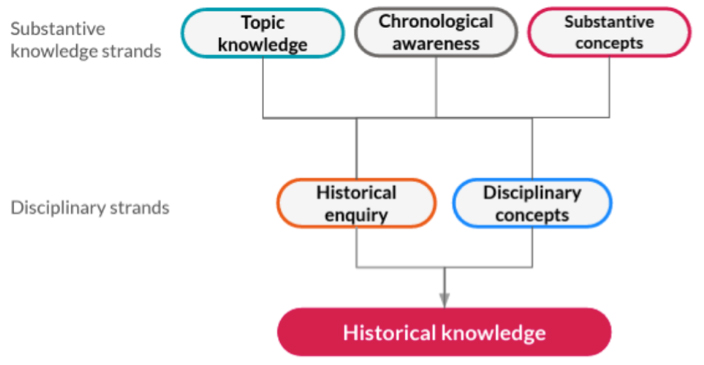
Our curriculum emphasises the importance of historical knowledge being shaped by disciplinary approaches. These strands are interwoven through all our History themes to create engaging and enriching learning experiences which allow children to investigate history as historians do.
Chronological awareness is developed through compare and contrast activities leading to a deeper understanding of where events and people fit chronologically. This will then support children in building a mental timeline they can refer to throughout their learning in Key stage 2 and identify connections, contrasts and trends over time.
Our key substantive concepts are: power, invasion, settlement and migration, empire, civilisation, religion, trade, achievements of humankind, society and culture. Some of these are introduced in Key stage 1,clearly identified in Year 3 and 4 and revisited again in Year 5 and 6 allowing knowledge of these key concepts to grow through different contexts.
Our learning is organised around a historical enquiry based question and children are encouraged to follow the cycle of question, investigate, interpret, evaluate and conclude and communicate when answering questions.
Through our curriculum, we develop children’s understanding of the following disciplinary concepts: change and continuity, cause and consequence, similarities and differences, historical significance, historical interpretations and sources of evidence.
In addition to learning, we have school history leaders that lead assemblies, plan events and clubs that promote a love of history and liaise with pupils on their history learning.
Links